
On this page
A robot moving across a table is an engaging sight, but the valuable learning question is what the children did to make it work. Did they plan a sequence, test an instruction, notice an error or explain a change? Coding and robotics become more meaningful when parents can see the thinking behind the equipment.
This guide explains a few useful ideas without promising that a particular activity produces a career or a guaranteed academic result. It also suggests questions to ask about a school’s current programme. Access to a device is only one part of the picture; the task, teaching and learner participation matter too.
Coding is about giving clear instructions
At a simple level, coding involves expressing instructions in a form a system can follow. A beginner might arrange a sequence, compare what they expected with what happened and change the instructions. More experienced learners may work with increasingly complex conditions, data or programs.
Parents can ask an accessible question: “What did you want it to do, and what happened instead?” That invites a child to describe a plan and examine a result. The answer is more informative than asking whether the child has finished a level or used a particular brand of software.
Robotics connects instructions with physical results
Robotics adds a physical object or system to that process. A learner may need to consider both the instructions and the way a model is built. If a model does not behave as intended, the problem might be in the sequence, a connection, the structure or the assumptions made before testing.
This creates a useful setting for careful observation. Encourage learners to change one thing, test again and describe what they noticed. Do not treat a working model as the only sign of worthwhile participation. A learner who can explain why an attempt failed may have something important to contribute to the next attempt.
The activity should match the stage
For younger learners, an appropriate introduction may involve physical sequences, patterns, building and simple instructions, with or without a screen. Older learners may be ready for a more complex project, a coding environment or a task that combines measurements and a model. Ask the educator how the chosen activity fits the group.
Avoid assuming that expensive equipment or advanced terminology automatically makes a programme stronger. A short, understandable problem that children can discuss may reveal more learning than a complex demonstration completed mainly by an adult. Ask what the learners themselves plan, make, test and explain.
Collaboration needs a task, not just shared seating
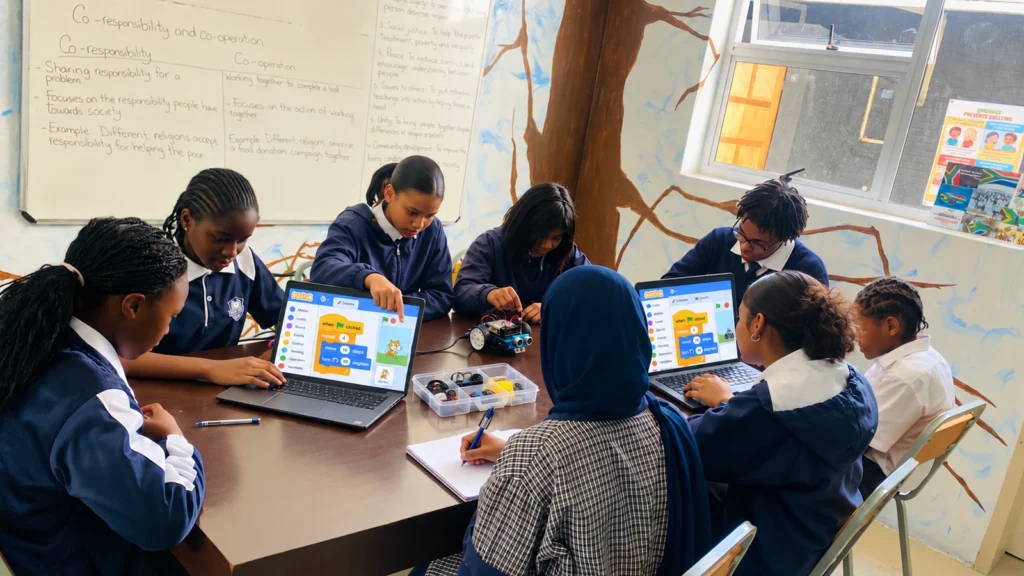
Placing learners around a laptop does not automatically create useful collaboration. Ask how participation is organised. Can different learners explain the plan? Are they taking turns meaningfully? Does one person control the device while others watch, or are there ways for everyone to contribute?
A practical group might divide planning, building, checking and explanation, then change roles. That is an example to discuss, not a claim that every classroom uses the same arrangement. The important point is to examine how the task encourages learners to participate and communicate rather than simply counting the number of devices in the photograph.
Ask how the work connects with the wider curriculum
Coding and robotics can be discussed alongside mathematics, science, design and communication, but the connection should be explained in a specific task. What are learners measuring, representing or testing? How do they record what happened? What must they explain to someone else?
The Department of Basic Education’s Foundation Phase curriculum resource page includes coding and robotics resources. Parents should still ask an individual school about its current grade-level implementation, rather than treating a national resource listing as proof of a particular campus timetable.
What to ask when visiting Allied
Allied’s STEM and future skills page and curriculum overview provide a starting point for a campus conversation. If you are considering Allied School Robertsham, ask what practical learning applies to your child’s intended grade and how it fits with the wider programme.
- What problem are learners trying to solve?
- What do they do themselves, and where does the educator guide them?
- How is a task adapted for beginners or learners who need help?
- How do learners test and explain their results?
- Which current activities are available for the relevant group or grade?
- Are there additional materials, access requirements or costs?
Use a gallery image to identify a question, not to assume that every depicted project runs on a fixed schedule. Ask for current details, especially if a specific activity is important to your school choice. A clear explanation of an ordinary task is often more useful than a technology slogan.
Encourage curiosity without buying a laboratory
At home, you can discuss sequences in a recipe, explain the steps of a game or compare two ways of building a simple model. The purpose is conversation and experimentation, not turning family time into another assessment. Follow the child’s interest and keep activities appropriate and supervised.
When practical learning is part of your shortlist, the school-choice guide helps you compare it with support, routines and cost.
To explore the school programme, book a Robertsham campus tour. Ask to understand the age-appropriate activities and the thinking learners practise. Coding and robotics are most useful to evaluate through real tasks, participation and explanation, rather than a promise about a distant career.
Fees, programme availability and admissions arrangements can change. Check the current branch information and speak to the relevant team. Our editorial standards.
Published 24 November 2026 · Updated 24 November 2026